
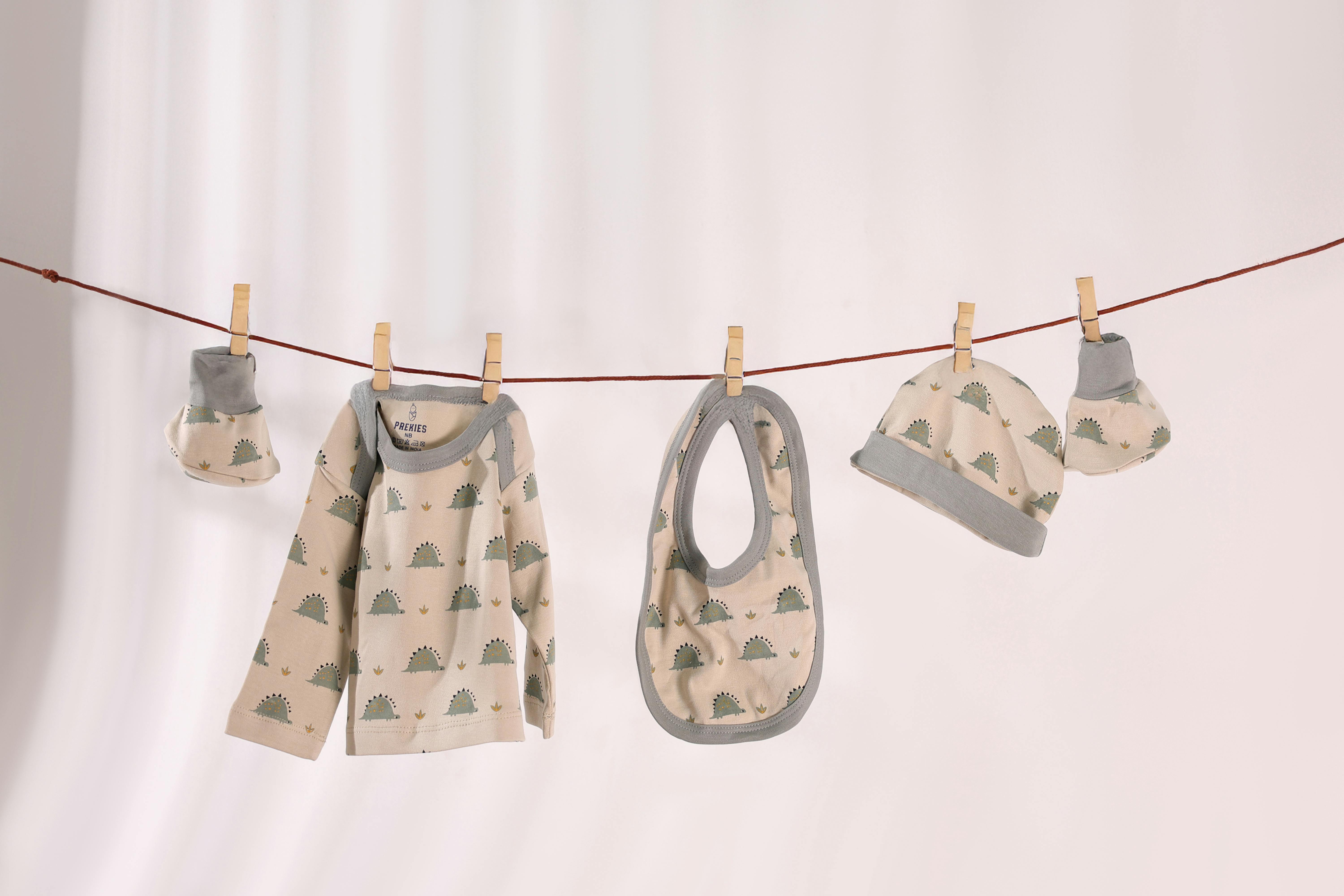
A garment labelled for a three-month-old may fit a newborn or nobody in the household. The labelling system is measuring something other than the child.
Age is a proxy for size
Clothing is sized by age because age is the one thing a buyer reliably knows, particularly when buying a gift for a baby they have not met.
Size at a given age varies across a wide range even among children growing entirely normally, so the proxy is weak from the start.
Babies born early, born large, or growing at the edges of the expected range diverge from the label immediately, and the divergence is not evidence of a problem.
There is no shared measurement behind the label
Manufacturers set their own dimensions for each age band, based on their own fit models and their own market.
Two garments labelled identically can differ substantially in length, width and neck opening, and the difference is often larger between brands than between adjacent size bands.
Sizes also differ between countries. Imported clothing frequently runs to a different scale, and conversion charts approximate rather than translate.
Growth is fastest exactly when sizing is finest
The first year involves the most rapid growth of a life, and the size bands in that year are narrow, so a garment can fit for a matter of weeks.
This is why families acquire clothing that is never worn, and why the second-hand market in baby clothes is dominated by items in near-new condition.
Buying slightly ahead is the common adaptation, with the trade-off that a garment too large can be a hazard in some designs.
Some sizing details are safety-relevant
Cords and drawstrings around the neck and hood are restricted or prohibited in children's clothing under standards in many countries, because of strangulation and entrapment risk.
Sleepwear is subject to flammability requirements in several jurisdictions, and those requirements interact with fit, since loose garments behave differently near a heat source.
Small decorative components that can detach are covered by the same small-parts testing applied to toys, and are worth checking on garments bought outside regulated retail.
Measuring is more reliable than the label
Comparing a garment against one that currently fits, or against the child's length, gives a more accurate result than the age on the tag.
Brands generally publish the measurements behind their size bands, and those figures are more useful for comparison than the age labels are.
None of this reflects on the child's growth, which is assessed on a chart by a health professional rather than inferred from how clothes fit.